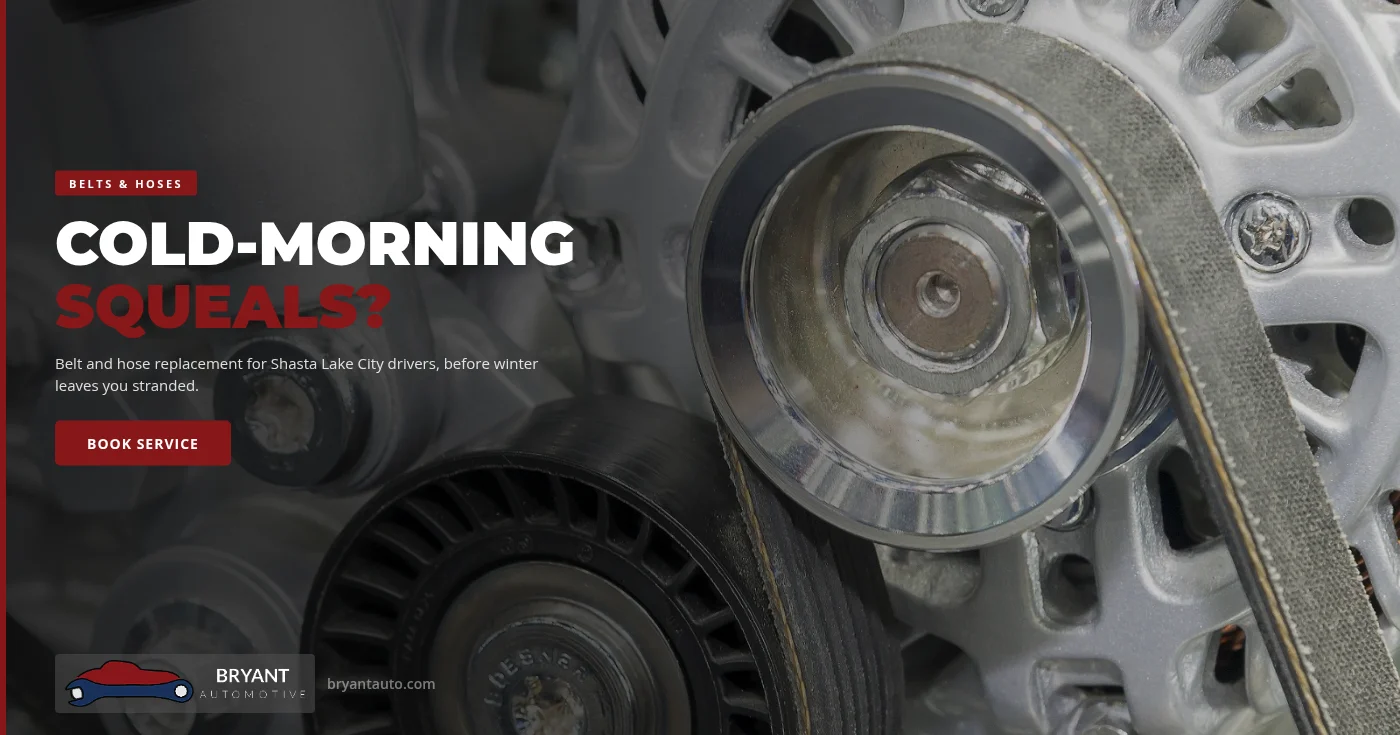
That high-pitched squeal when you turn the key on a frosty morning is easy to ignore. It fades after a minute, the heater eventually warms up, and you head off to work. For many drivers, though, that noise is the first warning that a belt or hose is wearing out. If you’ve been searching for belt and hose replacement Shasta Lake City drivers can count on before winter, this guide is for you.
Belts and hoses are some of the most overlooked parts under the hood. They’re made of rubber, they’re out of sight, and they usually work quietly for years. In this part of Northern California, they spend the summer baking in triple-digit heat and then face chilly, damp mornings once fall arrives. That combination wears rubber down faster than many people expect, and it tends to show up right when you need reliable heat and charging the most.
Here at Bryant Automotive, we’ve been keeping local families on the road since 1968, and we see this pattern every November. Below, we’ll explain why cold snaps are hard on belts and hoses, what your serpentine belt actually powers, the warning signs to watch for, what happens when something fails, how we check these parts, and how often they typically need replacing.
Why November Cold Snaps Are Hard on Belts and Hoses in Shasta Lake City
Shasta Lake City sits just north of Redding in the foothills, and November is when the weather really starts to swing. Afternoons can still feel mild, but mornings often drop toward the upper 30s, with frost becoming more common as the month goes on. For a closer look at local temperature normals, the National Weather Service office in Sacramento publishes forecasts and climate information for our region. Exact averages vary from year to year, but the daily swing is what matters most for your engine.
Heat damage you can’t see
Long stretches of summer days over 100 degrees age rubber from the inside out. Belts lose flexibility and hoses can harden or weaken internally. By the time cooler weather arrives, many of these parts are already partly worn, even if they look fine from the outside.
Cold, wet mornings
Cold rubber is stiffer and grips the pulleys less effectively. Add morning moisture, dew, frost or the rain that usually picks up in November, and a tired belt is more likely to slip and squeal on startup. Hoses, meanwhile, expand and contract every time the engine heats up and cools down. Hundreds of those cycles over a season put stress on aging clamps and connections, which is why a coolant hose leak often appears in late fall rather than in mid-summer.
What Your Serpentine Belt Powers (Alternator, Water Pump, A/C and Power Steering)
Most modern engines use a single long, ribbed belt, called a serpentine belt, that snakes around several pulleys at the front of the engine. That one belt can be responsible for a surprising amount of work:
- Alternator: charges your battery and powers your lights, heater fan, wipers and electronics while you drive.
- Water pump: on many engines, the serpentine belt turns the water pump that circulates coolant. On others, the water pump is driven by the timing belt or chain instead, so it depends on your vehicle.
- A/C compressor: keeps your air conditioning working and also helps defog your windshield on damp mornings. If your climate control isn’t performing well, our A/C and heating repair service can help sort it out.
- Power steering pump: on vehicles with hydraulic power steering, the belt keeps steering light and responsive.
Because so much depends on one belt, a failure rarely stays small. Lose the belt and you can lose charging, cooling and steering assist at the same time.
It’s also worth knowing that most belts made in roughly the last two decades use a material called EPDM rubber. EPDM is tougher than older belt materials, but it wears differently. Instead of cracking in obvious ways, it gradually loses material from the ribs, a bit like a tire losing tread. That means a belt can look clean and crack-free while still being worn enough to slip. This is one reason serpentine belt replacement is often overdue on cars whose owners assume the belt “looks okay.”
Warning Signs: Squeals, Chirps, Cracks, Glazing and Soft or Swollen Hoses
Your car usually tells you something is wrong before a belt or hose fails completely. Here’s what to listen and look for.
Belt warning signs
- A squealing belt on cold start: a loud squeal for the first minute or two that fades as the engine warms often points to a worn or glazed belt, or a weak automatic tensioner.
- Chirping: a rhythmic chirp can mean a pulley is slightly out of alignment or a bearing is wearing.
- Cracks or missing chunks: older belts may show cracks across the ribs or pieces breaking away.
- Glazing: a shiny, slick surface on the belt means it has been slipping and generating heat.
- Squealing when you turn the wheel or switch on the A/C: extra load on the belt exposes a slipping belt quickly.
Hose warning signs
- Soft, mushy spots, especially near the clamps. Coolant hoses often break down from the inside, so a hose can look fine but feel spongy.
- Swelling or bulging when the engine is warm.
- Cracks, hardness or brittleness on older hoses.
- Crusty white, green or orange residue around fittings, a common sign of a slow coolant hose leak.
- A sweet smell after driving, or small puddles under the front of the car.
If you notice any of these, it’s a good idea to have the system checked before a cold morning turns a warning into a breakdown.
How a Failed Belt or Hose Turns Into Overheating, a Dead Battery or No Heat
Belts and hoses rarely fail at a convenient moment. Here’s how a small worn part can escalate.
Dead battery and warning lights
If the serpentine belt slips badly or snaps, the alternator stops charging. Your car then runs on battery power alone, and once the battery drains, the engine shuts down. You may see a battery light, other dash warnings or even a check engine light first. If something lights up on your dashboard, our check engine light and diagnostics service can pinpoint whether the belt, alternator or something else is to blame.
Overheating
On engines where the belt drives the water pump, a broken belt stops coolant flow almost immediately, and temperatures can climb within minutes. A burst radiator hose does the same thing by dumping coolant onto the road. Driving even a short distance while overheating can warp cylinder heads or damage head gaskets, turning a modest radiator hose replacement into a much bigger engine repair.
No heat in the cabin
Your heater uses hot engine coolant, carried through heater hoses to a small radiator behind the dashboard called the heater core. A heater hose leak can leave you with no heat in the car, foggy windows on chilly mornings, and a steadily dropping coolant level. Prompt heater hose repair protects both your comfort and your engine, especially if you drive I-5 toward the mountains when winter storms bring chain controls.
What Happens During a Belt and Hose Check at Bryant Automotive
When you bring your vehicle to us, our ASE Certified technicians take a thorough, step-by-step approach and take time to explain what they find.
- Listening to the symptoms. We ask when the noise happens: cold start only, when turning, with the A/C on, or all the time. These details help narrow down the cause.
- Belt inspection. We look for cracks, glazing and damage, and we check rib wear with a gauge, since modern belts often wear without visible cracking.
- Tensioner and pulley check. A weak tensioner or a worn idler pulley can make a new belt squeal too, so we check tension, alignment and bearing noise.
- Hose inspection. We squeeze radiator and heater hoses to feel for soft or swollen sections, examine clamps and fittings, and look for residue that signals leaks.
- Cooling system check. When it makes sense, we pressure test the system to find leaks that only appear under heat and pressure.
- Written estimate and your approval. We give you a written estimate and explain what needs attention now versus what can wait. No work is performed without your approval.
While we work, you’re welcome to relax in our indoor, climate-controlled waiting area with free WiFi, complimentary coffee and a pet-friendly space. If you’d rather not wait, our free shuttle service and after-hours key drop-off make it easier to fit service into your week.
Belt and Hose Replacement Intervals for Commuters, Trucks and Diesels
There’s no single mileage that fits every vehicle, and your owner’s manual should always come first. That said, some general guidelines are commonly quoted across the industry:
- Serpentine belts: modern EPDM belts are often rated for somewhere around 60,000 to 100,000 miles, depending on the vehicle and driving conditions.
- Coolant hoses: many are replaced around four to five years or about 60,000 miles, or when the cooling system is serviced.
- Inspections: the Car Care Council, a nonprofit consumer education group, generally recommends having belts and hoses looked at during routine maintenance.
Daily commuters
Short trips, stop-and-go traffic and frequent cold starts are hard on belts and tensioners. A quick look during each oil change is an easy way to catch wear early.
Trucks and diesels
Pickups and diesel engines often run multiple belts, heavier-duty tensioners and larger cooling systems. Towing, hauling and long idling periods add heat that can age hoses faster. If you drive a work truck or a diesel, it’s smart to have belts and hoses checked more often. Our diesel repair team is familiar with the extra demands these engines face.
Older vehicles
If your car or truck is past 80,000 miles and you don’t know when the belt and hoses were last replaced, it may be worth an inspection before winter rather than waiting for a symptom.
Frequently Asked Questions About Belt and Hose Replacement in Shasta Lake City
Why does my car belt squeal on cold mornings?
Cold rubber is stiffer and grips less, and moisture on the pulleys reduces friction further. A worn, glazed belt or a weak tensioner makes the problem worse. If the squeal fades as the engine warms, the belt is often slipping and is likely due for inspection.
Can I keep driving with a squealing belt?
You may be able to for a short time, but it’s a gamble. A slipping belt can undercharge your battery, and a belt that breaks can leave you without charging, steering assist or engine cooling. We recommend having it checked soon.
Can I just spray belt dressing on it?
Most belt manufacturers advise against it. Belt dressing may quiet the noise temporarily, but it can attract dirt and mask the real cause, such as a worn belt or failing tensioner.
How long does belt and hose service take for Shasta Lake City drivers?
Many belt or hose jobs can be completed the same day, depending on the vehicle and parts availability. Some engines take longer because of how tightly packed the engine bay is. We’ll give you a time estimate along with your written estimate.
Schedule Belt and Hose Replacement in Shasta Lake City With Bryant Automotive
A cold-morning squeal or a soft, swollen hose is your car asking for attention before winter. Taking care of belt and hose replacement Shasta Lake City drivers need now can help you avoid overheating, a dead battery or a chilly cabin later. Here at Bryant Automotive, we’ve served generations of families since 1968 across Redding, Anderson, Shasta Lake City and Palo Cedro, with ASE Certified technicians and a no-surprises approach. Contact us today to schedule your belt and hose check and head into winter with peace of mind.
Can You Check My Belts and Hoses Before Winter Hits?
Absolutely. We’ve been helping local drivers get ready for the colder months since 1968, and a belt and hose check is one of the simplest ways to prevent a winter breakdown. Our ASE Certified technicians look closely at your serpentine belt, tensioner, pulleys, radiator hoses and heater hoses, and we take time to explain exactly what we find in plain language.
Here’s how we can help with belts, hoses and the systems they support:
- Serpentine belt replacement and tensioner or pulley service to stop cold-start squeals and chirps
- Radiator hose replacement and heater hose repair for leaks, soft spots and swelling
- Cooling system and radiator service to keep your engine at the right temperature
- Battery testing, starter and alternator work if a slipping belt has left your charging system struggling
- Heating and A/C repair when your cabin isn’t warming up or your windshield won’t clear
- Engine diagnostics when a warning light appears on your dashboard
We work on domestic cars and trucks, Asian and European vehicles, hybrids, diesels and fleet vehicles. Every job starts with a written estimate, and no work is performed without your approval. As an AAA Approved Auto Repair facility and NAPA AutoCare Center, we stand behind our work with a satisfaction guarantee.
Our free shuttle service, after-hours key drop-off and comfortable, pet-friendly waiting area make it easy to fit service into your day. Ready to get started? Request an appointment and let us help you head into winter with confidence.
Need it looked at?
Written estimate before we start. Nothing gets done without your OK.