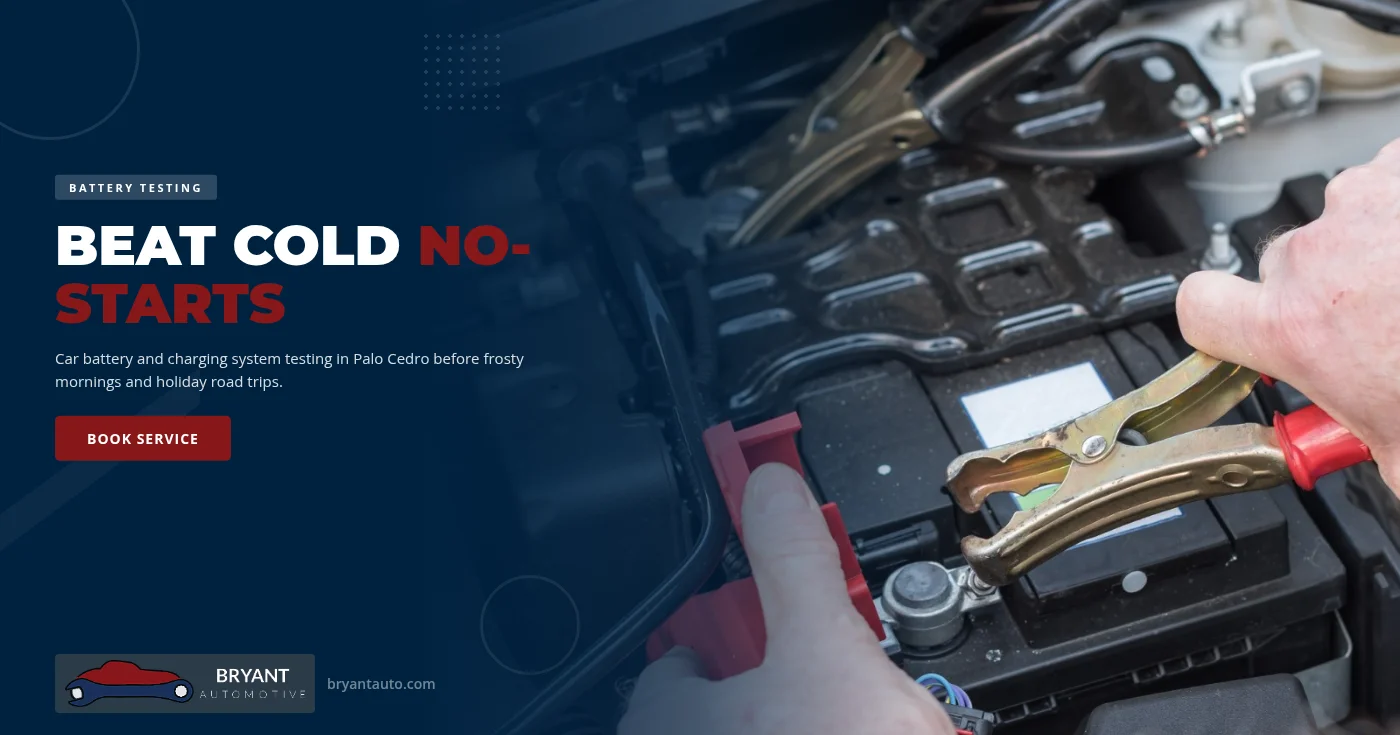
There’s nothing quite like a cold November morning, a full day ahead and a car that answers the key with a slow groan or a single click. Frosty mornings arrive quickly out here in late fall, which is why car battery testing in Palo Cedro is worth scheduling now, before the first hard frost and before you load up the car for Thanksgiving.
Here at Bryant Automotive, we’ve been helping local families keep their vehicles dependable since 1968. Over those decades we’ve learned that most no-starts don’t come out of nowhere. A battery usually gives warning signs for weeks, and a quick test can reveal them long before you’re stranded on a country road.
Why November Is When Weak Batteries Finally Give Up in Palo Cedro
A car battery doesn’t store electricity the way a bucket stores water. It makes power through a chemical reaction, and that reaction slows as temperatures drop. At the same time, cold engine oil thickens, so the starter has to work harder to turn the engine over. Less available power plus more demand is why a battery that seemed fine in September suddenly struggles in November.
A widely cited rule of thumb, often attributed to AAA and battery makers, is that a battery loses roughly a third of its strength at freezing and more than half near 0°F, while the engine may need up to twice the power to start. Exact figures vary by battery type and age, but the trend holds: cold weather exposes weakness.
East of Redding, November nights commonly dip into the high 30s, and low-lying rural spots often see frost. Afternoons may still feel mild, which is why so many drivers are caught off guard. The car starts fine at 3 p.m., then won’t cooperate at 6:30 the next morning.
How Summer Heat in the North State Quietly Damages Your Battery
It surprises a lot of people, but heat is usually harder on a battery than cold. Long stretches of 100-degree days speed up corrosion on the internal plates and cause the fluid inside the battery to evaporate. That damage builds quietly all summer.
Then fall arrives. The first cold snap demands full cranking power, and the battery simply doesn’t have it anymore. In other words, summer does the damage and winter sends the bill.
The Battery Council International points to heat as one of the biggest factors in shortening battery life. Most batteries are commonly expected to last somewhere around three to five years, but in hot inland climates like ours, it’s not unusual for one to wear out closer to the shorter end of that range.
That’s why we pay close attention to battery age. If yours is three years old or more and has been through a few North State summers, it’s a good candidate for testing this fall, even if it hasn’t given you any trouble yet. You can usually find a date code on a sticker or stamped into the case, and if you can’t, we’ll help you locate it.
Warning Signs of a Weak Battery: Slow Cranks, Dim Lights and Clicking
Batteries rarely die without a hint. Here’s how to tell if your car battery is weak before it fails:
- Slow or labored cranking. The engine turns over sluggishly, especially on cold mornings.
- Clicking when you turn the key. Rapid clicking often means there isn’t enough power to spin the starter; a single loud click can point to the starter itself.
- Dim headlights or interior lights, particularly at idle or right after starting.
- A battery or charging warning light on the dash.
- Electrical quirks such as a flickering dash, a radio that resets or slow power windows.
- Corrosion on the terminals, a white, green or bluish crust.
- A swollen case or a rotten-egg smell, which can signal overheating or overcharging and calls for prompt attention.
Some modern vehicles hide these signs well. Push-button-start cars and vehicles with stop-start systems manage power so smoothly that the first obvious symptom may be a no-start. Newer vehicles may also store voltage-related trouble codes, which our check engine light and diagnostics service can read and interpret.
What a Professional Battery Load Test and Charging System Check Includes
A quick voltage reading in a parking lot can’t tell the whole story. A battery can show a healthy 12.6 volts and still lack the cranking power to start your engine on a frosty morning. That’s why our technicians look at both the battery and the system that keeps it charged.
Battery Condition
We start with a visual inspection of the case, terminals, cables and hold-down. Then we perform a car battery load test or conductance test, which compares your battery’s real performance against its cold cranking amps (CCA) rating. This shows how much starting power is truly left, not just whether the battery holds a surface charge.
Charging System Check
Next comes a charging system check and alternator testing. With the engine running, a healthy charging system typically produces somewhere around 13.7 to 14.7 volts, though specs vary by manufacturer. We also watch how far voltage drops during cranking, which helps reveal starter or cable problems.
Clear Results
At Bryant Automotive, our ASE Certified technicians take the time to explain what we found in plain language. We provide written estimates before any work begins, and nothing is replaced without your approval.
Battery, Alternator or Starter? Pinpointing the Real Cause of a No-Start
“Is it my battery or my alternator?” is one of the most common questions we hear. These parts work as a team, so a failure in one often looks like a failure in another.
- The battery supplies the burst of power needed to start the engine.
- The starter uses that power to turn the engine over.
- The alternator recharges the battery and runs the electrical system once the engine is running.
A few general patterns can point the way. If the car starts after a jump and then runs fine, the battery may be weak or not getting fully recharged. If the car dies shortly after a jump, or the lights dim as you drive, the alternator is a likely suspect. If the lights and radio work normally but you hear a single click, or nothing at all, the starter or a connection may be the problem.
These are only clues. A corroded cable, a loose ground or a hidden electrical draw can mimic any of them. Replacing a battery when the alternator is at fault just means you’ll be stranded again in a few weeks with a new battery that’s run down too.
That’s where testing pays off. We handle battery replacement, starter and alternator repair and electrical system diagnosis, so we can find the real cause and fix the right part the first time.
Short Country Trips, Parked Vehicles and Other Palo Cedro Battery Drains
Rural driving habits can be surprisingly tough on a battery. Starting the engine uses a big chunk of stored energy, and it takes steady driving to put that energy back. A quick run to the mailbox or the feed store may not be long enough to fully recharge, especially when you’re also running the heater, defroster and headlights.
Vehicles that sit are another common issue. Many local households have a farm truck, an RV, a tow vehicle or a weekend car that goes weeks without running. Even switched off, modern vehicles draw a little power for clocks, alarms and computer memory. Add an accessory that doesn’t shut off properly, known as a parasitic drain, and a battery can go flat in a matter of weeks.
A few habits help:
- Take a longer drive at least once a week when you can.
- Use a quality battery maintainer on vehicles that sit for long periods.
- Keep terminals clean and connections tight.
- Have us check for a parasitic drain if a battery keeps going dead.
Getting Your Battery Ready for Thanksgiving and Holiday Travel
The holidays bring some of the busiest travel days of the year, and AAA’s forecasts consistently show that most travelers go by car. You can find the latest projections in the AAA Newsroom. AAA has also long reported that dead batteries are among the most common reasons drivers call for roadside help.
For many local families, holiday travel means a long haul down I-5 toward Sacramento or the Bay Area, or a trip north over the Siskiyous. Others head toward the mountains on SR-299 or SR-44, where temperatures can drop well below freezing. Chain controls and traffic can mean long stretches of idling with the heater, wipers and lights running, a real test for a tired battery.
Before you leave, we recommend:
- A battery test, especially if your battery is three or more years old.
- A charging system check to confirm the alternator is keeping up.
- An inspection of belts, hoses and the cooling system.
- Fresh oil and fluids; our oil change service is an easy add-on.
- Jumper cables or a jump pack, a blanket and a phone charger in the car.
Frequently Asked Questions About Car Battery Testing in Palo Cedro
How long do car batteries last in Northern California heat?
Many batteries are expected to last around three to five years, but hot inland summers often push that toward the shorter end. Age is only part of the picture, so testing is the best way to know where yours stands.
Why does my car start fine in the afternoon but struggle in the morning?
Overnight cold lowers the battery’s available power and thickens engine oil. A battery with little reserve may manage on a warm afternoon but not at dawn, a classic sign it’s time for a cold weather battery check.
Can Palo Cedro drivers get battery replacement at your shop?
Yes. We regularly help drivers from across the area east of Redding, and our shuttle service and after-hours key drop-off make it easier to fit a visit into a busy schedule.
Do hybrids need battery testing too?
Yes. Hybrids rely on a conventional 12-volt battery to power up their systems. We test it and the related components as part of our hybrid repair service, though we don’t service high-voltage EV battery packs.
Schedule Car Battery Testing in Palo Cedro Before the Cold Sets In
Cold mornings and holiday road trips are coming whether your battery is ready or not. A few minutes of testing now can spare you a stranded morning or a long roadside wait far from home. Here at Bryant Automotive, we’ve been keeping local drivers on the road since 1968, and we proudly serve Palo Cedro, Redding, Anderson and Shasta Lake City.
Browse our full range of auto repair services, schedule an appointment online, or contact Bryant Automotive today to book car battery testing in Palo Cedro before the first hard frost.
Why Should You Trust Us With Your Battery and Charging System?
We know how frustrating it is when your car won’t start on a cold morning, and we know how much you count on your vehicle for holiday trips, school runs and errands into town. Since 1968, we’ve been helping generations of local families keep their cars and trucks dependable, and we treat every battery test with the same care we’d give our own vehicles.
When you bring your vehicle to us, here’s what you can expect:
- Thorough testing of your battery, starter and alternator, not just a quick voltage reading.
- ASE Certified technicians who take the time to explain what we found in plain language.
- Written estimates before any work begins, and no work performed without your approval.
- A no surprise fees policy and an honest pricing pledge.
- Experience with many vehicle types, including domestic, Asian and European cars, trucks, diesels and hybrids.
- Convenient extras such as shuttle service, after-hours key drop-off and a comfortable, pet-friendly waiting area with WiFi and coffee.
We’re proud to be a AAA Approved Auto Repair facility and a NAPA AutoCare Center, and we back our work with a satisfaction guarantee. Whether you need a simple battery test, a battery replacement or a full starter and alternator repair, we’ll help you make an informed decision that fits your vehicle and your plans.
Ready to head into the colder months with peace of mind? Schedule an appointment with us today.
Need it looked at?
Written estimate before we start. Nothing gets done without your OK.